Sunday, May 2, 2010

A Weekend of Celebrations (2 Parts)

A Weekend of Celebrations – Part 1
  It was a fun weekend of reunions, a sacred union and a silver birthday.

  Ugandans know how to celebrate. They very much enjoy parties and know how to dress “smartly,” make speeches and prepare delicious food.

  Amanda and I helped to host a 25th birthday party (the silver birthday) for a Uganda friend, Susan, on Friday evening. Birthday parties are rare here as most do not observe their birthdays. Susan, who was raised at a local orphanage, said she had not celebrated her birthday since leaving the orphanage at age 18 – seven years ago. A broad, beautiful smile hardly left Susan’s face the entire evening as she reveled in some American games, the praise and encouragement of her friends, enjoyed a delicious meal, featuring traditional African foods, and feasted on not just one, but two cakes.

                                                                        Susan, center, prepares to cut her cake.

  It was truly a delight to be a part of blessing someone who was so very happy and grateful for the occasion. I believe for those of us from the U.S., we take it for granted that our birthday will be recognized in some way each year. But, here, when a birthday is observed (maybe once every few years) it is truly a celebration. And, it was truly a delightful evening for a delightful person!

  The weekend also held two happy reunions. I exited the kitchen at the SHIM office Friday afternoon to see a face I had not beheld for more than three years. I met dear Sarah during my first visit to Uganda (from Oct. 2006-March 2007) as we were “neighbors” on the island’s YWAM base. She was a sweet and warm friend who remained very vivid in my memory. When I came to Uganda this past January, Sarah was one person I definitely wanted to see again. But, since I had left in spring 2007, she had continued with her high school education and was no longer living on the island. I wasn’t sure how or when I would meet her again.

  Sarah was as excited to see me on Friday as I was to see her. She had changed a bit, but I recognized her by her beautiful smile. It was an unexpected, yet happy reunion!

  (By the way, I am writing this post on Saturday afternoon as I wear a dark blue formal dress and silver high heels – no, not my normal writing attire. I am waiting for the big event of the weekend – a wedding of one of the island’s teachers – to begin. It was supposed to start at 3 p.m., but it is now nearing 5 p.m. and few people have arrived at the church. But, this is Uganda. :)

  We learned Saturday morning that Lynet was traveling from Kenya to Jinja. Just about a month ago, Lynet was living as the sixth wife of a Muslim man on the island. Through mercy ministry to Lynet and her small prematurely-born baby, Cowsala, Karina and others of us were able to reach out and show the love of Jesus to this young mother. It was a happy day in March when Lynet returned to her Savior, restoring a relationship begun in her youth. To begin a new life, Lynet and her little girl, renamed “Hope,” then left the island to join family in her Kenyan homeland.

Lynet and Baby Hope

  Hope was born in November - four months early. When she left the island, she weighed less than 4 pounds and her arms and legs were so thin. But, to our delight this weekend, she had grown some and gained weight – now tipping the scales at 6 ½ pounds. She even sported a double chin! It was with joy that we were reunited with this dear mother and her baby!
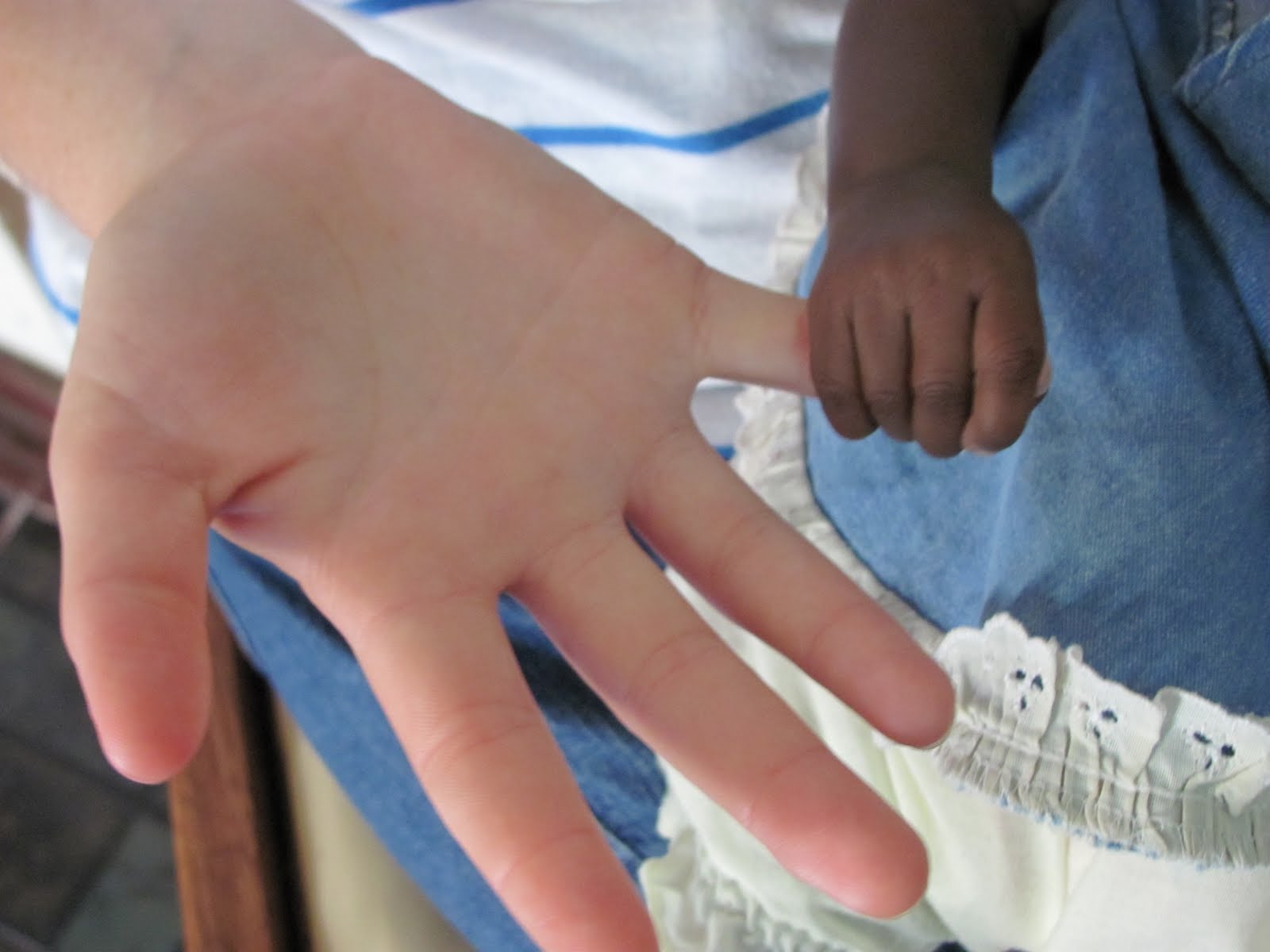
Hope's tiny hand gripping my pinkie finger.

 Time is passing and we still await the beginning of the wedding festivities. I will write part 2 after the celebration.

~~~~~~~~~~~~~~~~~~~~~~~~~~~~~~~~~~~~~~~~~~~

A Weekend of Celebrations – Part 2

  I mentioned in one of my previous posts that one phrase I like to quote here is “Hurry up and wait.” Ugandans are not known for being punctual and functions rarely start on time. However, yesterday and today’s events were beyond anything I had experienced so far.

  We had been told that the introduction of one of our island teachers and her fiance would be held from 11 a.m.-2 p.m. Saturday in a village located on a peninsula that juts out into Lake Victoria. An introduction is a formal event where the couple is formally “introduced” and the bride price is negotiated. What transpires during an introduction varies depending on what part of the country you are from. We learned last night that in central Uganda (where we are), they can be quite long.

  The wedding was scheduled to start at 3 p.m. the same day at a church in Jinja. Gloria, SHIM’s secretary, arrived at the church at around 2 p.m. to help prepare. She was also to be our “scout” to let us know when to come, so we didn’t arrive too early and wait too long.

Amanda and I in our dresses for the wedding.

  Amanda and I had special formal dresses “tailor-made” for the occasion and bought matching shoes, jewelry and handbags. (Truthfully, I never thought I would buy a pair of heels in Uganda, but I did.) We prepared throughout the morning and into the afternoon of the big day – fixing our hair, applying our makeup and putting on our dresses and shoes. However, we waited and waited…and waited. We continued to check in with Gloria as time transpired. Five people were present and then seven. At around 6 p.m., three hours after the wedding was to begin, we figured we should head to the church. When we arrived, we found about 20-25 people there, but none of the wedding party. It began to grow dark and we continued to wait.

  Entertainment in the interim consisted of visiting, listening to the practicing praise and worship team, performing our own unique wedding march, and slapping the many mosquitoes that believed the wedding feast had already begun.

  Around 7 p.m., Gloria received a phone call from the officiating pastor saying that the wedding would be postponed until 9 a.m. the following morning. However, Gloria, knowing the pastor is a jokester, believed he was teasing and the bride was actually going to arrive at 9 p.m. that night.

  Amanda and I and decided we could wait no longer (especially since we were unsure of how we would get home after the late ceremony), so we left around 8:30 p.m. – five and a half hours after the wedding was to start. Before departing we heard that the wedding party’s vehicles had become stuck in the mud as they traveled from the introduction to the church. We also learned that it is illegal to marry after 6 p.m. in Uganda, so as to prevent any hidden or illegal activity.

  This morning (Sunday), Gloria informed us the wedding would be held at 9 a.m. at the officiating pastor’s church. So Amanda and I once again donned our fancy dresses and shoes and headed to the church, hoping we would actually get to witness a wedding.

  We arrived at around 9 a.m. and waited for church and/or the wedding to begin. The pastor had told the couple that if they arrived at the church before mid-day, he would marry them. We continued through prayer, praise and worship, and testimonies, with no sign of the bride or groom. Finally, near the end of the pastor’s sermon, the groom and his best man arrived. Honestly, I breathed a sigh of relief.

The happy couple

  At about 12:30 p.m., about 20 hours after the wedding was to actually begin, it started. It was a brief, but happy celebration. The bride looked beautiful and the groom shy, but happy. The guests were excited and the cake and sodas were yummy. What more could you want? It was worth the wait.

P.S. I am quite curious to hear the bride's side of the story.

Monday, April 19, 2010

“Normals” of Uganda, Part 2

I started this series a couple of weeks ago, so if you want to read the first part, keep scrolling.

I was standing in line at the bank a few weeks ago and came up with quite a list of “normals” of Uganda. These are things – mostly practices and behaviors, which are considered entirely common and normal here, but would likely be conversely “abnormal” for those of us from the U.S. One of my greatest challenges since arriving here is trying to understand the culture. The longer I am here, the more I realize how different it is from my home environment and culture, the way I was raised and the way I was taught.

The following is meant to be humorous and to help you catch a glimpse of Ugandan life.

Being carried to the boat.

“Waiting”
  One of my favorite phrases to repeat here is “Hurry up, and wait.” Time is definitely not as strictly followed here as it is in more developed countries. For instance, this past week I was with friends who were going to catch a boat from the island. The boat was expected to arrive at around 9:30 a.m., but didn’t show until after 10 (mostly because of the morning rain. Rain can delay many things – see the first part of this series for more on that.) The following day, when I wanted to catch the same boat, I arrived around 9:30 a.m. and found the boat ready to leave the shore. I nearly missed it. Another morning I rushed to another camp where the boats are usually pretty punctual. I sat and sat and sat, for an hour as several boats passed by. I finally left on a boat about an hour later. So, you may be rushed to do things, but may also find yourself only having to wait for the thing to actually occur.

“Queues” or “Lines”
  I commented to Amanda yesterday, as we stood in a Jinja restaurant, “That is one thing the Ugandans didn’t learn from the British, is queues (lines).” We were picking up food for a friend and I thought there was some kind of an order of being served at the counter. But as people kept coming in behind us and filling any openings at the front, I realized I was being passed by and needed to be more aggressive in making my order. It seems only in banks, where they have signs and ropes to tell you to form a line, do people here actually seem to make them. For me, who was taught to be courteous from a young age, it is hard for me to think about being pushy and to tolerate those who don’t seem to understand, “first come, first served.” Ah, I guess just more opportunities to learn flexibility and patience. : )

Worship in an island church.

“Church Services”
  If you asked me to describe the Ugandan church services in one word, I would say “joyous.” On the island we know church has begun by the sound of the drums. As we walk closer, we hear singing and shouting coming from within. There is very little, if no sitting during the praise and worship part of the service, but much movement – swaying, clapping, greeting, dancing and even jumping. These are the people’s expressions of joy – joy to be in God’s house, to be in His presence, to be alive and able to praise the awesome God who has given them life. But, it really only makes sense that we should respond to our God with such joy and excitement!

“Football”
  If you want to get a Ugandan really talking, ask about their favorite football team. This is football as in soccer, not American football. It is the sport of Uganda – others, less “noble,” are left far in the dust. I like soccer and have played a little, but have never really watched much on television, so unfortunately, I can’t contribute much on the topic. A few weeks ago, I was part of a SHIM team visiting two islands further into the lake. Lufu seemed well-organized, even having “streets” and many iron-sheet roofs. However, I was still surprised when I spotted a large satellite dish there. My first thought was “Oh, so they can get television here.” But, I was told that “It is for football.” A satellite dish just for a sport?

“Painted Shoes”
 I was sitting in a bus a couple of months ago and spotted a very interesting site out the window. The bus was parked in an area of business, including the seller of used shoes. The shoes arrived at the seller of various colors, but when offered to the customers, most of them were black. I learned that many shoes are painted because black shoes sell better. Pretty industrious, eh?

My friend Flex holding a cellphone.

“Beeping”
  Nearly every Ugandan owns a cell phone. There are few landlines here so the best way to reach anyone is via cell phone. Of course, though, airtime costs you and not everyone can afford to keep enough time on their phone to call and talk to their friends and family. So, they resort to “beeping.” This means you call someone, letting it only ring once or twice, with the expectation that the person you “beeped,” and who you assume has more airtime than you, will call you back so you can talk. This term of “beeping” can also be used when you visit someone for only a short time.

“Typos”
   I don’t have a long list of pet peeves, but there is one that is very near the top of the list – typographical errors - typos for short. I know I am definitely not exempt from making such boo-boos, in fact I invite you to please tell me if you see typos on my blog here. My mom, and former teacher, is good at catching such errors. ; ) Typos are abundant here in Uganda – on signs, on vehicles, in newspapers, in brochures, in school information, etc. – just about anywhere you might look. “Inconvenience,” “receipt,” “welcome” and “compliment” are all commonly misspelled. Having been in the newspaper business and often proofing my fellow writers’ work, I find it often difficult to not let out a cry of anguish when I see such glaring typos. I can make exceptions for the common man, but not for those who claim to have higher education. Ah, well, I guess the world can only be fixed one word at a time. : )


Monday, April 12, 2010

One Step at a Time...

  A Ugandan beauty

 Some encouragement from one of my favorite devotionals, "Streams in the Desert."

 "This is the blessed life - not anxious to see far down the road nor overly concerned about the next step, not eager to choose the path nor weighted down with the heavy responsibilities of the future, but quietly following the Shepherd, one step at a time.

 "God is in every tomorrow,
Therefore I live for today,
Certain of finding at sunrise,
Guidance and strength for my way;
Power for each moment of weakness,
Hope for each moment of pain,
Comfort for every sorrow,
Sunshine and joy after rain."


Source: "Streams in the Desert," pages 32-33.

Monday, April 5, 2010

"Normals" in Uganda

Note: The following is meant to be a humorous piece, so please don't feel I am in any way "bashing" the Ugandan culture. It was also written more than a week ago, so the introductory paragraph is a bit outdated.

  As I ran to catch the boat to leave the island this morning, navigating puddles and squishy brown mud, I thought about how what I consider normal here in Uganda, would not be normal for those living in the U.S. So, I thought I would share a few "normals" with you. Enjoy!

 "Public transport" - This can mean cramming into a taxi (like a Volkswagen bus), which says "licensed for 14 passengers" on the side, but can really hold about 21 people, plus bags and maybe a couple of chickens. "Public transport" can also mean riding in a large wooden boat, packed with soda crates, bags of maize (a type of corn) or fish, maybe a live animal or two ( I have at different times ridden with a pig, goat, duck and chickens), luggage and a number of other passengers. It can also mean boarding a large bus and hurtling down a dirt road as you question whether or not the driver has ever had any training and pray you don't tip over in the ditch or crash into an oncoming vehicle, which may be in your "lane."

 "Public behavior" - It is perfectly normal to pick your nose and to openly breastfeed while in public. However, if you are a woman, you should not show your knees.

Our "toilet" - pit latrine.
  "Trips to the PL" - To use the pit latrine (an outside toilet - it is actually just a hole), it may mean putting on your skirt over your pjs, your raincoat if it is raining, grabbing a handful of toilet paper (which is kept in your bedroom, not the room that houses the toilet), perhaps taking an umbrella, putting on your sandals, going outside, greeting anyone you may encounter, and walking half a block to the toilet. It may also mean meeting various critters while you are in there. The other day I scared a lizard so bad that he fell down the hole. And, this morning a bat flew in and hung right over my head. I just tried to remember that he was probably more scared than I was. : )

        Ants climbing the wall - literally.

  "Ants" - It is quite normal to encounter little sugar ants pretty much anywhere - on your food (just brush them off), on your clothes (just brush them off), in your food (a little protein won't hurt anyone), attacking a crumb or small bit of food left on the table or that has fallen on the floor, and/or ones climbing your walls - literally.

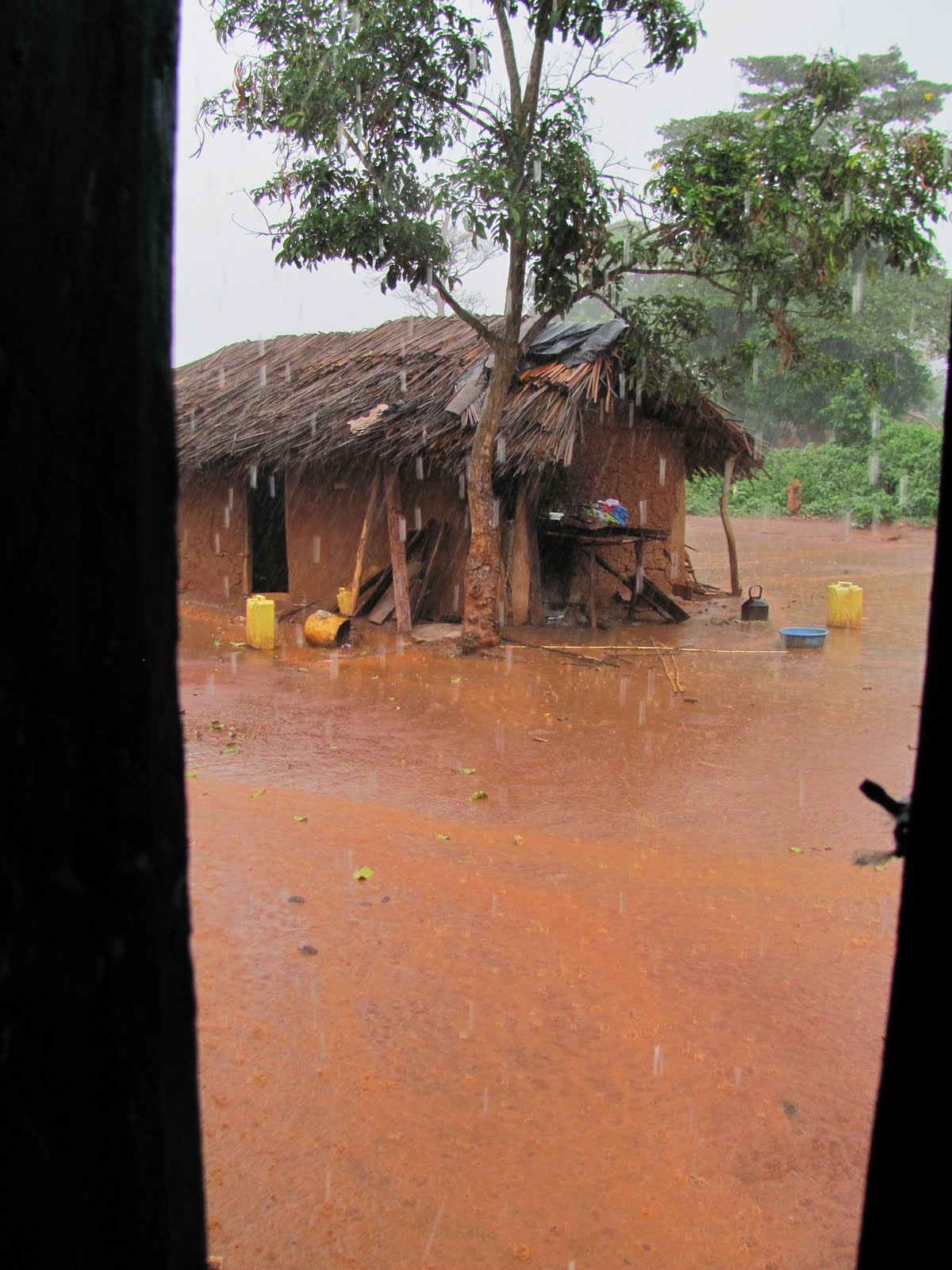
A Ugandan rainstorm.

 "Rain" - Rain can stop almost anything in Uganda. It can delay chores, travel, meetings, etc. It may be just a sprinkle, but sounds so much worse on tin roofs. It is always a good excuse to stay inside and do quiet work. : )

 "Greetings" - It is very normal and expected to greet nearly everyone you meet on the island or the village, whether you know them or not. This also usually means stopping - stop walking, stop working, etc. - to talk to the person. As an American, I have to make myself think about this and stop. To rush by or not take the time to talk is very rude here. By the way, your greeting changes depending on the time of day. "Waszaotya" means "How are you?" in the morning. "Oliotya" is used in the afternoon or any time of day, and "Osveyotya" is used in the evening.

         Ugandan shillings.

 Paying in "1000s" - Ugandan currency is shillings. One U.S. dollar is equivalent to about 2000 Ugandan shillings, so it is not uncommon to pay in "hundreds" or "thousands" and to talk of "millions." It does make one feel rich. : )

 "Conveniences" - Having Internet, but not running water is normal on the island. Having a cell phone, but not a landline is normal. Having a fridge, but only one that can run when the sun is shining, is normal.

     Me riding a boda-boda - a motorcycle.

 "More on Travel" - Riding on the back of a motorcycle (a boda-boda) is normal. Riding without a helmet is also normal. Haggling with the driver over the price to get from here to there is normal.

Our bathhouse - boys on the left, girls on the right.

 "Bathing" - Normally, bathing on the island means filling my solar shower with rainwater from a collection tank several hours before I want to bathe and setting the shower in the sun. The bath house is an outdoor cement structure, with walls, but no roof or door.

Even Flex enjoys a good cup of Ugandan tea. : )

 "Teatime" - Having hot black tea in this hot climate is very normal. Uganda was once a British protectorate, so taking black tea and biscuits (cookies) is common. Teatime is more common in the mornings or after you have been traveling. And, it is normally served to guests who come to visit.

  Okay, so these are just a few of the "normals" I encounter every day. Perhaps I will come up with some others for a future blog post. : ) Thanks for reading!

Monday, March 22, 2010

Thirsty?

Sometimes you don’t truly value something until it is a scarcity. Or perhaps not recognize its worth until it is gone entirely.

 Heard the phrase, “Water, water everywhere, but nary a drop to drink”?

 The green, algea-covered water of Lake Victoria.

 I am living on an island on the second largest lake on the world. Yet, you couldn’t pay me enough money for me to drink straight from Lake Victoria. As you can see in the above photo, the water has a lot of algae, as well as many other bacteria and other “cooties” that can cause a plethora of diseases.

 I am very thankful for Duvon McGuire, the founder of New Life International, a Christian outreach organization. While as a missionary kid in Ecuador, Duvon became very ill when he drank contaminated water. Motivated by his own brush with death, he developed a water filtration system, using common table salt and a 12-volt battery to make chlorine, in his garage and eventually patented the machine and started New Life to share his design with the rest of the world, specifically those who do not have access to clean water. We have been using this particular system on the islands for about five years. We can take the filthy water and purify it enough for safe drinking water. Remarkable, huh?

The type of jerrican where we store our purified water - safe for drinking.

 For the last two weeks, the water and sanitation team of Shepherd’s Heart has been conducting follow-up meetings on various islands that have received these filtration systems. This remarkable machine costs several thousand dollars, yet they are freely shared with needy communities, but with several conditions. They must form an oversight committee, develop a safe place for the system to operate, take care of it, and formulate a way of collecting the water, purifying it and then redistributing it. Unfortunately, the team has encountered many camps or villages that seem unable to meet these conditions. Some have abused the equipment, using it for other purposes and damaging it.

 Other communities refuse to work together, saying they do not want to contribute to something that might benefit another – someone from a different tribe, language or country – people they dislike or even hate. Some sites have had their systems recently removed because they could not follow through with what was expected.

 We find it baffling how the people do not value such a gift enough to use it and benefit from it. While trying to “hurt” others by not helping them, they are actually harming themselves. So many people are sick and some die on the islands simply because they are drinking dirty water. But, clean water is within their grasp. So, why do they refuse such an essential gift?

 My primary conclusion to this question is that they are blinded by Satan. As we know, Satan’s only purposes are to steal, kill and destroy. He has long had a stronghold on this great continent and kept people under bondage in so many areas. He does not want them to succeed, nor even be healthy. He wants them forever under his cruel dominance.

 This week I have been memorizing John 6:35. “Jesus said to them, ‘I am the bread of life. Whoever comes to me shall not hunger and whoever believes in me shall never thirst.’” (Emphasis mine.)

 I find it amazing that we can find in Jesus the “water” to satisfy our spiritual thirst, not just for today or for a week or a month, but forever. He says when we “drink” of Him, we will never, ever thirst again. Incredible!! And, I can guarantee that He offers the purest, cleanest, most refreshing water anywhere!

 Yet why I don’t drink more often and deeply of Him? Why don’t I remain at the thirst-quenching pool of His Word? Why do I try to swallow what I think will satisfy my soul, when those things only leave me more parched than before I drank of them? Am I more concerned for my physical thirst than my spiritual thirst?

 So, what is the answer for me and the people of the islands? Jesus said “If you abide in my word, you are truly my disciples, and you will know the truth, and the truth will set you free.” (John 8:31b-32)

 It is my prayer that the people of the islands will come to know the Living Water – Jesus – and will be set free.

 “Thus says the Lord: ‘In a time of favor I have answered you; in a day of salvation I have helped you; I will keep you and give you as a covenant to the people, to establish the land, to apportion the desolate heritages, saying to the prisoners, ‘Come out,’ to those who are in darkness, ‘Appear.’ They shall feed along the ways; on all bare heights shall be their pasture; they shall not hunger or thirst, neither scorching wind nor sun shall strike them, for he who has pity on them will lead them, and by springs of water will guide them.” – Isaiah 50:8-10 (Emphasis mine)


Note: According to New Life’s website, www.waterfortheworld.com, approximately 25,000 people die each day from waterborne diseases.

Friday, March 12, 2010

The Blessing of Friendship

The foursome - Amanda, Ruthie, Shanna and Katie

 I marvel at the miracle of friendship.

 It is amazing to me how two people, who begin as complete strangers, can through shared experiences, shared beliefs, shared thoughts and/or shared environments, find themselves transported into the realm of friendship, with hearts united.

  This week I saw two dear friends off as they returned to America. I have had the joy of their company for the last two months as they visited Uganda for different reasons. Katie arrived from South Carolina in late January to conduct her practicum in Uganda - a big step in earning her master's degree in public health this May.

 Katie with students from the Lingira Primary School.

 Katie doesn't know this, but when I first began communicating with her by e-mail, prior to her arrival, I pictured her as a shy, sophisticated blonde. Boy, was I wrong! Katie has dark, curly hair and is Italian, which means she is very expressive. : ) She is not shy and quiet, but very outgoing.

  Katie and I are actually opposite in a lot of ways. Yet, through conversations over coffee, washing dishes together, shopping together, sharing a room and other shared experiences, we moved from being strangers to being friends - almost without noticing. Katie is very personable, loving and loves quality time, including "tea time." : ) I enjoyed watching her learn more about God and His care and desires for her. She was certainly a blessing to me during her stay here!

 I know Shanna because we are both from Clatskanie and attended the same church at one time. She is 13 years younger than I and we really didn't see each other so often - until she came to Uganda. She came to minister and to observe missionaries to see if missions work might be in God's future plans for her.

 At first I had a hard time reading Shanna because she was so quiet and shy, but the longer she stayed, the more comfortable she became and the more I saw of her true personality. I so admire her spirit and perseverance, which shone through a number of challenges, including several health difficulties while she was here. Through her entire stay in Uganda, her main desire was to receive all that God had for her. And, because of her desire and thirst for God's best, I believe she received and learned much during her stay here.

Shanna with a few of her young island friends.
 
 Shanna also blessed and touched the lives of many while in Uganda - the young Muslim mother who recommitted her life to Christ, the young Muslim boy who claimed ownership of Shanna's hand whenever she was nearby, the secondary students who were blessed by her example and her sharing of God's Word with them, and those of us at SHIM, who enjoyed her smile, humor, wisdom and her artistic talent. (Thank you, Shanna, for the beautiful mural - her first ever!)

Shanna and her mural - to remind us that God is our refuge and fortress, based on Psalm 91.

 I marvel at the miracle of friendship and how God uses people in our lives - to bless us, to grow us, to challenge us, to cause us to look to Him.

 Thank you, Lord, for the blessing of friendship, and thank you for the blessing of Katie and Shanna. May you richly bless them as they return to the U.S. Uganda won't be the same because of them.

Monday, March 1, 2010

Counting Your Way Through the Day

For those who think I may have retired from the blogging business, let me assure you that I haven’t, but I have been “away” for a bit. : ) The pace of my work here in Uganda has picked up in the past few weeks and the days seem to be flying by. I can hardly believe it is March and I am nearing two months since my arrival.

I am becoming more and more accustomed to life here and definitely feeling at home. Sometimes I have to remind myself how blessed I am to be here, to be working where I am, with the people I am privileged to join. There are times, like this evening, when I need to stop and look around at the beauty surrounding me, in the foliage, the fauna, the sunsets, the sky and the people.

I want my experiences to remain fresh and new, like the dawning of each new day. I don’t want to take for granted the incredible privilege I have in being here. I don’t want to miss the small and large blessings that occur, on a daily basis.

Every day God showers us with His blessings, beginning with the rising of the sun at night, sustaining us through the day and closing out each day with a sunset as His closing signature. Whether you are in Uganda, in northwest Oregon, elsewhere in the U.S., or in another foreign country, there are blessings to be found. I believe as we approach God daily with a thankful heart, He will give us eyes to see His daily blessings.

Like the hymn says, “Count your blessings, name them one by one. Count your blessings, see what God has done. Count your blessings, name them one by one. Count your many blessings, see what God has done.”

What blessings can you count today?